
Prefab vs. Traditional Bathroom Units: Which Option Works Better for Modern Construction?
Summary: Prefabricated and traditional bathroom units offer different advantages depending on project requirements. Prefabricated solutions are manufactured in controlled facilities and can support consistent quality, streamlined installation, and reduced on-site construction activities. Traditional bathrooms offer greater flexibility for customized designs but require coordination among multiple trades at the construction site. A modular bathroom pod can be a practical option for hotels, apartments, healthcare facilities, and other developments that require standardized bathroom layouts. BathSystem USA offers modular construction solutions for projects exploring factory-built building approaches.
Bathrooms are among the most complex spaces to build because they require coordinated plumbing, electrical systems, waterproofing, ventilation, fixtures, and interior finishes. For developers and construction professionals, choosing the right building method can influence project timelines, labor requirements, quality control, and overall costs. This is why the comparison between prefab vs. traditional bathroom units has become increasingly relevant in modern construction.
Traditional bathrooms are generally built and finished directly at the construction site, while prefabricated options are manufactured in a controlled facility and transported for installation. A modular bathroom pod takes this concept further by integrating essential bathroom components into a factory-built unit. Understanding the differences can help project teams determine which approach best suits their building requirements.
What Are Prefabricated Bathroom Units?
Prefabricated bathroom units are bathroom spaces manufactured partly or fully away from the construction site. Depending on the design, they may include pre-installed plumbing connections, electrical components, waterproofing, wall finishes, flooring, fixtures, and fittings.
Once manufactured, the units are transported to the project location and installed within the building. This approach shifts several construction activities from the site to a controlled production environment.
Prefab bathroom solutions are used in different types of developments, including:
Hotels and hospitality properties
Apartment buildings and residential developments
Student housing and dormitories
Healthcare facilities
Workforce accommodation
Modular and prefabricated housing projects
Because many components are assembled before delivery, these units can help simplify certain stages of construction, particularly when multiple bathrooms with similar specifications are required.
What Is a Traditional Bathroom Unit?
A traditional bathroom is constructed directly at the project site. Workers complete each stage of the process, from preparing the floor and installing plumbing to waterproofing, tiling, fitting fixtures, and completing electrical work.
This method allows builders to adjust the design and finishes during construction. It can be suitable for projects that require unique layouts, custom architectural features, or significant design flexibility.
However, traditional construction involves coordinating multiple trades and scheduling different activities in the correct sequence. Delays in plumbing, tiling, material delivery, or labor availability can affect the overall construction schedule.
Prefab vs. Traditional Bathroom Units: Key Differences
Both construction methods can produce functional and durable bathrooms. However, their workflows and project requirements differ.
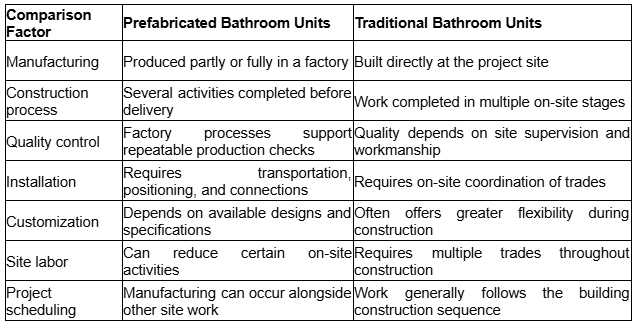
The most suitable choice depends on project scale, building design, transportation access, budget, and installation requirements.
Benefits of Using a Modular Bathroom Pod
A modular bathroom pod is a factory-built bathroom unit designed to arrive at the site with many essential components already installed. It can be a practical option for developments that need multiple bathrooms with consistent layouts and specifications.
1. Controlled Manufacturing Environment
Factory production allows components to be assembled in a more controlled setting. Standardized processes and inspection procedures can support consistent workmanship across multiple units.
This can be especially useful for hotels, apartment buildings, and accommodation projects where bathrooms follow similar specifications.
2. Potentially Faster On-Site Installation
Because much of the bathroom assembly takes place before delivery, certain on-site activities may be reduced. Once the building is ready and the required connections are available, the unit can be positioned and connected according to the installation plan.
This may help project teams coordinate bathroom installation alongside other construction activities. Actual time savings depend on manufacturing schedules, transportation, site readiness, and installation complexity.
3. More Predictable Construction Coordination
Traditional bathroom construction involves scheduling plumbers, electricians, tilers, waterproofing specialists, and other trades. Prefabrication moves several of these activities into a factory workflow.
This can make coordination more predictable, particularly for projects involving repeated bathroom layouts.
4. Consistency Across Multiple Units
Large residential and hospitality developments may require dozens or hundreds of bathrooms with similar layouts. Factory manufacturing can help maintain consistency in dimensions, fixtures, finishes, and component placement.
This can simplify planning, maintenance, and replacement considerations over the building's lifecycle.
5. Reduced On-Site Construction Activity
A prefabricated bathroom can reduce some wet trades and material handling at the construction site. This may help limit certain sources of site congestion and waste, although packaging, transportation, and installation still require careful planning.
When Are Traditional Bathroom Units the Better Choice?
Prefabricated solutions are not suitable for every project. Traditional construction may be preferable when the bathroom design is highly customized or the building has unusual structural and spatial requirements.
For example, custom residential properties may require unique tile patterns, specialized fixtures, irregular dimensions, or architectural features that are easier to execute on-site.
Traditional construction can also be more practical when transportation access is restricted or when the building cannot accommodate the delivery and positioning of a complete bathroom unit.
The decision should account for the entire project rather than focusing only on construction speed or the initial price.
Important Factors to Consider Before Choosing a Bathroom Construction Method
Before selecting between prefabricated and traditional construction, evaluate the following factors:
Project size and repetition: Prefabricated units may offer greater advantages when several bathrooms share the same design. A single custom bathroom may be easier to construct traditionally.
Building design: Check whether the structure can accommodate the dimensions, weight, delivery route, and installation method of a prefabricated unit.
Plumbing and electrical connections: Confirm that the building's service locations align with the bathroom design. Connection points should be coordinated early to avoid expensive modifications.
Transportation and site access: Consider delivery vehicle access, lifting equipment, floor loading, installation openings, and available space for positioning the unit.
Waterproofing and ventilation: Both construction methods require suitable waterproofing, drainage, ventilation, and compliance with applicable building codes.
Maintenance and replacement: Review the accessibility of plumbing connections, fixtures, and service components. Consider how repairs will be handled after installation.
How BathSystem USA Supports Modular Construction
For developers and organizations exploring factory-built construction, BathSystem USA offers modular building solutions for different housing and facility applications.
Its modular approach can be relevant to projects where repeatable layouts, coordinated building systems, and efficient installation planning are important. When evaluating a bathroom pod or other modular solution, project teams should review available configurations, technical specifications, plumbing and electrical requirements, delivery arrangements, and installation procedures.
It is also important to confirm whether a particular bathroom solution can be integrated with the intended building structure and project design. Early coordination between the manufacturer, architect, contractor, and engineering team can help identify technical requirements before production begins.
Making the Right Choice for Your Construction Project
The decision between prefab and traditional bathroom units depends on the project's design, scale, schedule, and construction requirements. Prefabricated solutions can support consistent production and reduce certain on-site activities, while traditional construction provides greater flexibility for custom layouts and finishes.
For projects involving repeated bathroom designs, a modular bathroom pod may be worth evaluating as part of a broader modular construction strategy. By comparing installation requirements, total costs, building compatibility, and long-term maintenance needs, developers can select an approach that supports efficient and practical project delivery. BathSystem USA provides modular construction solutions worth exploring when assessing alternatives for modern building projects.
FAQs
1. What is the difference between prefab and traditional bathroom units?
Prefab bathroom units are manufactured partly or fully in a factory before being transported for installation. Traditional bathroom units are constructed directly at the project site through separate plumbing, electrical, waterproofing, tiling, and finishing activities.
2. What is a modular bathroom pod?
A modular bathroom pod is a factory-built bathroom unit that incorporates essential components such as plumbing, fixtures, flooring, walls, and finishes. It is transported to the building site and installed according to the project's specifications.
3. Are prefabricated bathroom units suitable for hotels?
Yes. They can be suitable for hotels because multiple rooms often require bathrooms with similar layouts and specifications. Factory production can support consistency and simplify coordination across large developments.
4. Are modular bathroom pods more cost-effective than traditional bathrooms?
They can offer cost advantages in certain projects by reducing some on-site labor and coordination requirements. However, total costs depend on manufacturing, transportation, lifting, installation, utility connections, and project specifications.
5. Can prefabricated bathroom units be customized?
Customization depends on the manufacturer's capabilities and the project requirements. Dimensions, fixtures, finishes, layouts, and certain technical specifications may be adjustable, but these should be finalized before manufacturing begins.

HEY, I’M AUTHOR…
I’m a seasoned content writer and professional blogger passionate about creating engaging, insightful, and reader-focused content. I blend creativity, research, and experience to craft articles and blog posts that inform, connect, and leave a lasting impression.


JOIN MY MAILING LIST

Created with © systeme.io