
Hong Kong Company Registration: Requirements, Costs, and Process
Summary: Registering a Hong Kong company is straightforward when you know the rules. This guide covers the core requirements, current government fees, the step-by-step process, and ongoing compliance duties, so overseas founders can set up correctly, budget accurately, and move on to banking and operations without costly surprises or unnecessary delays.
Hong Kong is one of the easiest places in the world to start a company. It is also one of the easiest places to get small details wrong. A missing company secretary, an unclear business activity, or a mismatched name can slow everything down, and that matters because your company records will later be reviewed by your bank.
Here is a clear walkthrough of what you need, what it costs, and how the process works for Hong Kong company incorporation.
Which Company Type Should You Choose?
Most founders choose a private company limited by shares. According to Switzerland Global Enterprise’s guide to setting up in Hong Kong, most limited companies incorporated in Hong Kong are of this type. It is a separate legal entity, which protects your personal assets and gives banks and clients a familiar structure to work with.
Other options include a branch office of a foreign parent company or a representative office. These suit specific situations, such as testing the market, but they don’t create a separate legal entity in the same way.
Core Requirements
For a private limited company, you will need:
At least one director who is a natural person. A non-Hong Kong resident can be appointed as a director.
At least one shareholder. One person can be both the director and the shareholder.
A company secretary. If you have only one director, that director can’t also be the company secretary. A secretary who is an individual should ordinarily reside in Hong Kong, and a corporate secretary should have its registered office or place of business in Hong Kong.
A registered office in Hong Kong. This is a physical address, and it appears on the public register.
A unique company name. It can’t match one already on the Registrar’s index of company names.
According to 3E Accounting’s 2026 guide, there is no foreign ownership restriction and no minimum share capital, so overseas founders can hold the entire shareholding from day one.
How Much Does It Cost?
Government fees are modest. The figures below are for electronic filing and are current for 2026, as reported by 3E Accounting:
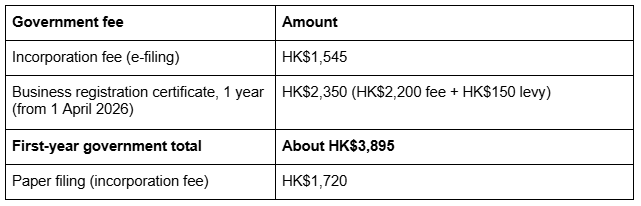
On top of this, most overseas founders pay a corporate service provider for document preparation, a company secretary and a registered office. These costs vary by provider and by how much support you need, so ask for a full breakdown before you commit.
Ongoing costs include the annual return filing fee, business registration renewal, accounting, audit and tax compliance.
Step-By-Step: The Registration Process
1. Decide your structure. Confirm who will be the director, shareholder and company secretary, and where your registered office will be.
2. Choose and check your company name. A name search helps you avoid conflicts. Keep the name consistent with your brand and your business activity.
3. Prepare the incorporation documents. The application includes Form NNC1 (for a company limited by shares), the Articles of Association and the notice to the Business Registration Office. Founders usually need passport copies and address details for each officer.
4. Submit the application. Filing through the Companies Registry’s e-Registry is the fastest route. Per 3E Accounting, a correctly prepared electronic application is normally approved in about an hour, while hard-copy filings take around four working days.
5. Receive your certificates. Once approved, you receive the certificate of incorporation, and the business registration certificate is issued with it under the one-stop service.
6. Set up your statutory records. Maintain your registers from day one, including the Significant Controllers Register.
7. Open your bank account. This is not a legal requirement, but it is usually a practical one. Banks will review your incorporation documents, your ownership structure and your business activity, so clean company records make this step much easier.
In practice, preparing the information takes longer than the approval itself. With a provider, the whole journey commonly takes three to five working days.
What Happens After Registration?
Registration is the start, not the finish. A few obligations to put on your calendar:
Annual return. The annual return (Form NAR1) is due within 42 days of your incorporation anniversary. The on-time fee reported by 3E is HK$105.
Business registration renewal. The certificate is renewed annually or every three years.
Audited accounts. Hong Kong companies generally need annual audited financial statements, although dormant companies are exempt.
Profits tax return. The first return typically arrives around 18 months after incorporation.
A Quick Word On Tax
Hong Kong follows a territorial tax system, meaning profits sourced outside Hong Kong are generally not subject to profits tax. For eligible companies, the first HK$2 million of assessable profits is taxed at 8.25%, with 16.5% above that. Where your profits are sourced depends on where the activity actually takes place, so a structured tax review is a smart step before you start trading.
Common Mistakes To Avoid
Appointing a sole director as company secretary
Using a vague business description that doesn’t match your real activity
Overlooking the Significant Controllers Register
Missing renewal and annual return deadlines
Delaying bank account planning until after Hong Kong company incorporation
Most of these are simple to avoid with a little preparation up front.
Start With A Structure That Works For You
A Hong Kong company is quick to register, but a well-built structure pays off for years. Getting the roles, the registered office and the business description right at the start makes banking, compliance and growth much smoother.
If you’d like help with company formation and a banking plan that fits your business, you can get started with Lion Business Co. and speak with our team.
Frequently Asked Questions
1. Can a non-resident register a Hong Kong company?
Yes. A non-Hong Kong resident can be appointed as a director, and there is no foreign ownership restriction. You will still need a company secretary and a registered office in Hong Kong.
2. How long does Hong Kong company registration take?
A correctly prepared electronic application is normally approved in about an hour, and paper filings take around four working days. With a service provider, the full process commonly takes three to five working days.
3. How much does it cost to register a company in Hong Kong?
First-year government fees are about HK$3,895 for electronic filing: HK$1,545 for incorporation and HK$2,350 for the one-year business registration certificate. Professional service fees are additional and vary by provider.
4. Do I need a Hong Kong office?
You need a registered office address in Hong Kong, which is a physical address on the public register. You don’t necessarily need a full operating office, but your bank will want to understand where and how your business operates.
5. What should I do after my company is registered?
Set up your statutory registers, plan for the annual return and audited accounts, and prepare for corporate bank account opening. With Lion Business Co, we can support both company formation and banking so the two steps work together.

HEY, I’M AUTHOR…
I’m a seasoned content writer and professional blogger passionate about creating engaging, insightful, and reader-focused content. I blend creativity, research, and experience to craft articles and blog posts that inform, connect, and leave a lasting impression.


JOIN MY MAILING LIST

Created with © systeme.io